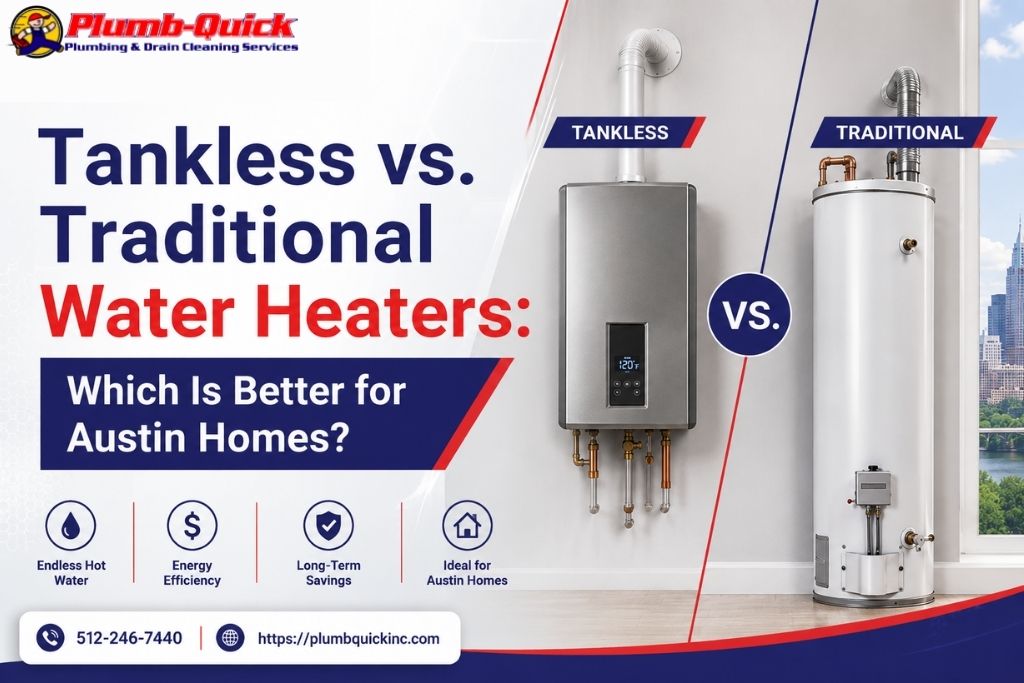
Tankless vs. Traditional Water Heaters: Which Is Better for Austin Homes?
Most homeowners do not think much about their water heater until it stops doing its job. Maybe the shower turns cold halfway through, hot water runs out before everyone is ready, or the same unit keeps needing repairs.
When it is time to replace the system, the choice can feel less straightforward than expected.
Should you install another traditional tank, or is it worth switching to a tankless model?
The tankless vs traditional water heater choice depends on more than the unit’s price. The number of people in your home, how often you use hot water at the same time, and what your existing plumbing can support all play a role.
Tankless vs. Traditional Water Heaters: What Is The Main Difference?
The biggest difference is simple: a traditional water heater stores hot water, while a tankless system heats it on demand.
Traditional Tank Water Heaters
A traditional water heater stores a set amount of heated water inside an insulated tank. When you turn on a shower, faucet, or appliance that needs hot water, the system draws from that stored supply.
As hot water leaves the tank, cold water enters, and the system reheats it.
The limitation is the amount of hot water available at one time. If several people shower back-to-back or multiple appliances are running, the tank can eventually run low and need time to recover.
Tankless Water Heaters
A tankless water heater does not keep a large amount of hot water inside a tank. Instead, it heats water as it flows through the unit.
When you turn on a hot water fixture, the system activates and begins heating the incoming water.
That is the main difference in the tankless vs tank water heater comparison. One prepares hot water before you need it, while the other produces it as you use it.
Hot Water Demand: Where the Real Difference Shows Up
A tankless system can provide hot water continuously, but that does not mean it can handle unlimited demand.
Every unit has a maximum capacity. If two showers, a dishwasher, and a washing machine are all using hot water at once, an undersized tankless system may struggle to keep up.
A traditional tank has the opposite limitation. It can provide the hot water stored inside it, but once you use it heavily, you may have to wait for more water to heat.
A Tankless System May Suit Homes That:
- Have frequent back-to-back showers
- Use hot water throughout the day
- Want to avoid waiting for a tank to recover
- Need to free up space used by a large tank
- Can support a properly sized system
A Traditional Tank May Suit Homes That:
- Have predictable hot water use
- Do not regularly run several fixtures at once
- Want a simpler replacement
- Prefer a lower upfront installation cost
Is a Tankless Water Heater More Energy Efficient?
Yes, a tankless water heater can be more energy efficient, depending on how much hot water your household uses.
A traditional tank uses energy to keep stored water hot, even when nobody is using it. A tankless unit heats water on demand, which can reduce energy lost while keeping a full tank heated.
The U.S. Department of Energy notes that tankless water heaters can be more energy efficient than conventional storage water heaters. However, actual savings depend on household hot water use and the system itself.
Still, energy efficiency is only one part of the overall cost. Switching to a tankless water heater may require changes to gas lines, venting, electrical connections, or plumbing. In some homes, that additional work can significantly affect the total upgrade cost.
What Makes One Option Better for an Austin Home?
Austin homes vary in size, plumbing layouts, and household water use. That is why choosing a new water heater should start with your home’s needs.
Austin’s moderately hard water can contribute to mineral and scale buildup over time, which can affect water heater performance. Regular maintenance can help manage buildup, although the type of service required may differ between systems.
Tankless May Be Worth Considering If You Want:
- Hot water on demand
- More available floor space
- A system sized around your household’s usage
- A long-term upgrade and a home that can support the installation
A Traditional Tank May Make More Sense If You Want:
- A straightforward replacement
- Lower upfront costs
- A familiar system
How Much Does Installation Affect the Cost?
Sometimes, installation is the biggest difference between the two options.
Replacing an existing tank with another tank is often more straightforward because the required connections and space may already be available.
Moving from a tank to a tankless unit can require additional work, including changes to:
- Gas supply
- Venting
- Electrical connections
- Water lines
- Installation location
For homeowners searching for water heater replacement in Austin, evaluating the existing setup first can reveal the actual installation requirements. It can also help you understand whether switching to tankless makes practical sense or whether another tank is the better fit.
Repairs and Maintenance: What Should Homeowners Expect?
Both systems can develop problems, and replacement is not always the first answer.
Traditional water heaters can experience sediment buildup, valve issues, heating component failures, and eventually tank problems. Tankless systems can also need servicing, particularly when mineral buildup affects internal components.
If you are dealing with inconsistent hot water, unusual noises, leaks, or other performance issues, professional water heater repair in Austin can help identify the real cause.
Conclusion
The tankless vs. traditional water heater decision isn’t about choosing the newer or more expensive option.
Tankless systems can be a good fit for homeowners who want on-demand hot water and have a home that can support the installation. Traditional water heaters can still be the better choice when a simpler replacement, lower upfront cost, and reliable stored hot water fit the household’s needs.
If your current water heater is leaking, struggling to keep up, or needing repairs more often, Plumb-Quick can inspect the system and explain what is the ideal option for your home.
Frequently Asked Questions
Is a tankless water heater better than a traditional water heater?
Not necessarily. A tankless unit can provide hot water on demand, while a traditional tank may be easier and less expensive to install. The better option depends on your household’s hot water use and installation setup.
Can a tankless water heater run out of hot water?
A tankless system does not run out of stored hot water. However, if too many fixtures demand hot water at once, an undersized unit may not keep up.
What are the disadvantages of a tankless water heater?
A tankless system can have a higher upfront installation cost and may require changes to gas lines, venting, electrical connections, or plumbing. Proper sizing and regular maintenance are also important.
Is it expensive to switch from a tank water heater to a tankless one?
It can be more expensive than replacing a tank with another tank. The final cost depends on the unit and whether your home needs installation upgrades.
Should I repair or replace my water heater?
An isolated problem may be worth repairing. However, repeated breakdowns, major leaks, declining performance, or an aging system may make replacement the better option.
What size tankless water heater does my home need?
The right size depends on how many fixtures use hot water at the same time, your household’s usage, and the incoming water temperature. A professional assessment can help determine the right capacity.
Plumbing Problem?
Talk to an Austin Plumber
Get professional plumbing help from non-commission technicians with honest pricing and reliable service for homes and businesses across Austin.
Our Latest Posts

What Are the Signs of a Sewer Line Problem?

When Should You Call a Plumber for a Clogged Drain?